 Oz
OzProductivity · 10 min read
Done Lists for Human and AI Work
Why logging completed work—by people and AI alike—may boost motivation, close cognitive loops, and build the accountability modern teams need.
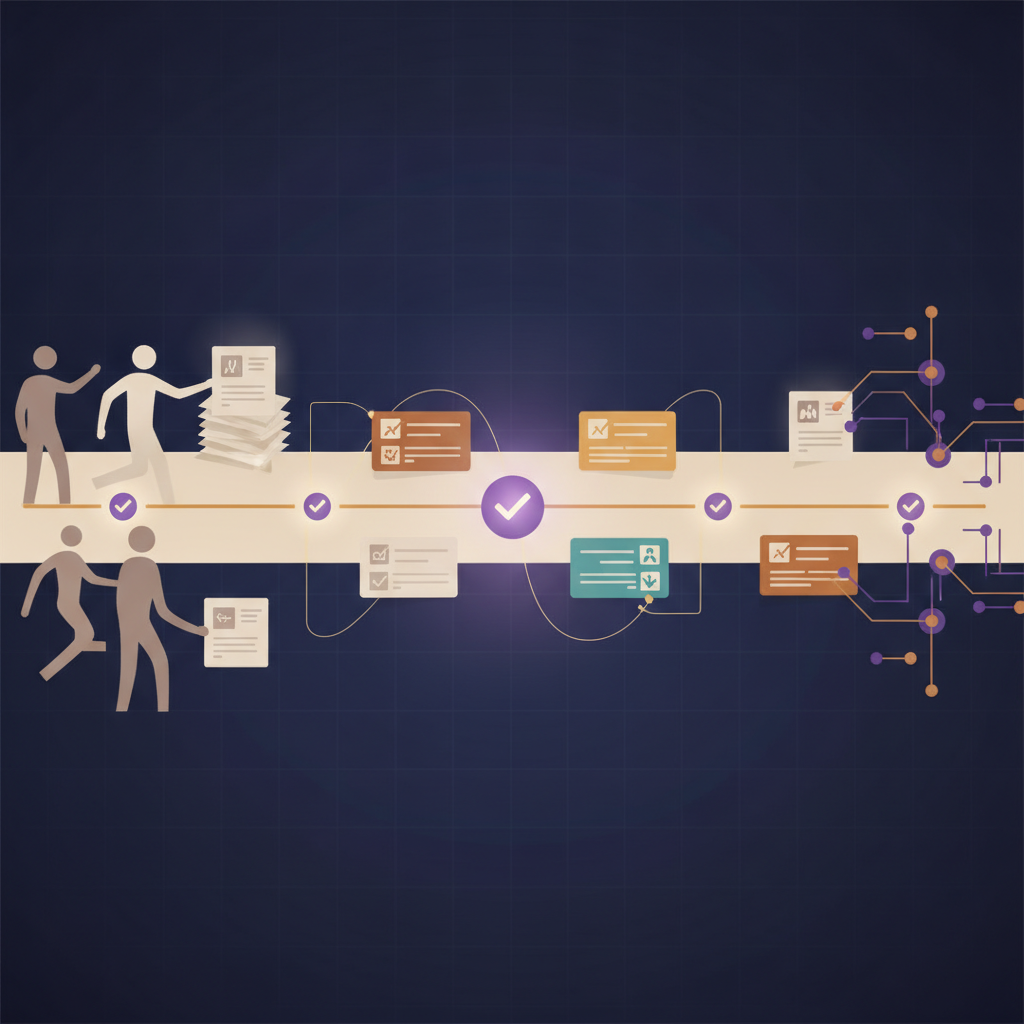
A done list is the simplest accountability tool most teams overlook. Instead of cataloguing what hasn't happened yet, it records what has—completed tasks, shipped outputs, and increasingly, actions taken by AI agents working alongside humans. Research in cognitive psychology, organizational behavior, and emerging AI governance all point toward the same conclusion: making completed work visible may be one of the most leveraged habits a modern team can build.
Why To-Do Lists Alone Fall Short
The to-do list has dominated productivity culture for decades, but the psychology behind it is more complicated than it first appears. Research in cognitive psychology shows that long to-do lists trigger decision fatigue and activate the brain's threat response. When working memory—which can only hold about four chunks of information at once—gets overloaded, the brain interprets the situation as a threat, resulting in avoidance, procrastination, and a creeping sense of always being behind.
The problem compounds as goals multiply. Prior research on implementation intentions had focused on the effectiveness of planning when you have a single goal. But in real life, people constantly juggle multiple goals, and the evidence suggests detailed planning loses much of its power as the list grows longer. The tool that works beautifully for one focused objective becomes unwieldy—and demoralizing—when it sprawls across a dozen competing priorities.
The result is familiar: a list that looms without spurring action, that rebukes without offering encouragement. It records what you haven't done yet, not what you have.
The Zeigarnik Effect and Cognitive Closure
One reason unfinished task lists feel so draining has a name in psychology. The Zeigarnik Effect is the psychological tendency for unfinished tasks to remain cognitively active, as shown in an influential study published in the Journal of Experimental Social Psychology in 2011. This produces low-level anxiety and intrusive thoughts, pulling attention away from current work.
The corrective mechanism is straightforward: recording completed tasks provides closure signals to the brain, reinforcing progress and reducing rumination. Writing down what you finished tells the brain it can stop holding that thread open. The cognitive load drops. Focus returns.
This is why done lists, kept consistently, can feel qualitatively different from a to-do list with items crossed off. The act of actively recording a completion—rather than simply striking through a pre-written item—appears to create a more deliberate closure signal.
The Progress Principle: Small Wins as the Engine of Motivation
If the Zeigarnik Effect explains why completion records reduce anxiety, the Progress Principle explains why they actively build motivation.
Professor Teresa Amabile and Steven Kramer wrote in detail about how progress can boost performance in their 2011 book, The Progress Principle. In their research, they asked 238 people from 26 project teams in seven major organizations to keep an anonymous diary, receiving more than 12,000 separate diary entries to analyze people's "inner work lives"—their perceptions, emotions, and motivation.
What they found was striking. Of all the good things that can boost inner work life, the single most important is simply making progress on meaningful work—even if that progress is a small step forward. This is the Progress Principle.
The implications are practical. If progress is the top motivator, then perceiving progress matters as much as making it. A done list makes progress perceptible. It converts the abstract sense of having worked hard into a concrete, scannable record.
Organizational psychologist Karl Weick defines a small win as "a concrete, complete, implemented outcome of moderate importance," and shows that small wins have power beyond themselves. "Once a small win has been accomplished, forces are set in motion that favor another small win," Weick explained. "When a solution is put in place, the next solvable problem often becomes more visible." A done list is, in effect, a log of small wins—each entry potentially setting the next one in motion.
The Dopamine Flywheel
The motivational effect of completion isn't only psychological in the abstract sense—it also has a neurochemical dimension. The dopamine effect significantly fuels enthusiasm for completing tasks. Checking off an item releases dopamine, imparting a sense of satisfaction and accomplishment. This neurochemical response forms a positive feedback loop, promoting continued task completion and sustained productivity.
Done lists may amplify this effect by making the act of recording a completion more intentional. When you write down what you finished, the act of recording is itself a small ritual of acknowledgment—a moment that can consolidate the dopamine signal into something more memorable than a mechanical checkmark.
Over time, this creates a flywheel: completed work → recorded completion → dopamine signal → motivation to complete the next item → recorded completion. The loop is self-reinforcing when the habit is maintained.
Visible Progress vs. Abstract Intention
The brain responds to visible progress, not abstract intention—and most people underestimate how much they try to do in a day. This mismatch between effort and perceived output is one of the quieter sources of workplace demoralization. Workers who genuinely accomplish a great deal often feel they haven't done enough, because their mental model of the day reflects the unfinished to-do list rather than the actual completed work.
Done lists reframe that mental model. They provide an evidence base for the day's work. And when tasks are tracked over time, patterns emerge: teams begin to plan more realistically, prioritize more effectively, and protect focused work blocks. The done list becomes a planning instrument—informing future to-do lists with actual data about what gets completed, at what pace, under what conditions.
The New Problem: AI Work Is Largely Invisible
The case for done lists was already strong for human teams. The rise of AI in the workplace has made it significantly more urgent.
AI adoption has reached a tipping point. According to recent workplace analytics data, AI adoption has nearly doubled in the last six months of 2024, with 75% of global knowledge workers now using AI tools regularly. But the work AI completes is rarely captured in any systematic record. It flows through conversations, drafts, summaries, and automated sequences without appearing in the shared accountability structures teams use to understand who—or what—did what.
This invisibility is not a minor inconvenience. Increased delegation of commercial, scientific, governmental, and personal activities to AI agents—systems capable of pursuing complex goals with limited supervision—may exacerbate existing societal risks and introduce new risks. Researchers note that information about where, why, how, and by whom certain AI agents are used—what they call "visibility"—is critical to governance and accountability objectives.
The visibility problem extends in multiple directions. WalkMe's 2025 workplace survey found that 78% of employees use AI tools not provided by their employer, and nearly half have avoided disclosing their AI use at work to sidestep judgment. Separately, according to a Cloud Security Alliance survey, 82% of enterprises discovered previously unknown AI agents running in their IT environments within the past year, many of them appearing multiple times. AI is doing work that no one formally recorded.
The Attribution Gap in Human-AI Collaboration
When AI contributes to completed work, a related question arises: who or what should receive credit?
As large language models are incorporated into co-creative workflows in increasingly complex ways, one challenge that arises is determining how to delineate authorship. Although there are well-established standards for crediting contributors when writing with human collaborators, requirements for crediting the use of AI are nascent and often simplistic. A 2025 CHI Conference study on human-AI co-creation found that norms around AI attribution remain underdeveloped relative to the pace at which AI is being incorporated into real work.
This matters not just for ethical reasons but for practical ones. When AI contributions go unrecorded, teams cannot accurately assess their own capacity, identify dependencies on specific tools, evaluate risk exposure, or learn from what worked. Attribution gaps are also capability gaps.
A shared done list—one that includes AI-completed work alongside human-completed work—is one concrete response to this problem. It doesn't require sophisticated governance infrastructure. It requires the discipline to record what actually happened, including who or what did it.
What a Shared Done List Looks Like in Practice
For human team members, a done list entry might be:
- Finalized Q3 competitive analysis draft
- Resolved customer escalation in Salesforce
- Completed three code reviews
For AI-assisted or AI-completed work, entries might look like:
- AI agent summarized 14 support tickets and categorized by theme
- AI drafted initial RFP response; reviewed and approved by [team member]
- Automated pipeline ran nightly data reconciliation; flagged two anomalies for human review
The key features of a useful done list entry—whether human or AI—are specificity, context, and attribution. Vague entries like "worked on project" or "AI helped with stuff" don't close cognitive loops, don't support planning, and don't build accountability. Specific entries do.
Practical Guidelines for Teams
Keep entries brief but specific. The goal is a scannable record, not a narrative. A sentence or two per item is usually sufficient.
Record at a consistent cadence. End-of-day or end-of-sprint recording tends to work better than real-time logging for most teams, because it allows natural consolidation of what was actually meaningful.
Include AI-completed actions explicitly. If an AI agent took an action, completed a task, or produced an artifact that the team is relying on, that entry belongs in the done list. Omitting AI contributions creates blind spots.
Note handoffs and approvals. When AI work required human review before use, recording that handoff clarifies accountability. It distinguishes "AI did this autonomously" from "AI drafted this; human approved it."
Review done lists in retrospectives. Aggregate done lists over a sprint or quarter and look for patterns: what got done consistently, what repeatedly didn't, where AI and human effort overlapped or complemented each other.
Don't retroactively inflate. The honesty of a done list is its primary value. Recording only what was genuinely completed—not what was started, partially done, or planned—preserves the integrity of the record.
From Individual Habit to Team Infrastructure
The done list concept originated as an individual productivity practice—a way for a single person to reorient from the demoralizing effect of an unchecked to-do list toward the motivating effect of acknowledged progress. That core insight remains valid and is supported by the psychological research reviewed above.
But the same mechanism scales. When a team shares a done list, the individual dopamine signal becomes collective acknowledgment. Progress that might otherwise go unnoticed—by colleagues, by managers, by the individuals doing the work—becomes visible and shared. This is what Amabile and Kramer found in their diary research: the perception of progress in meaningful work drives inner work life, and that perception depends on information being surfaced.
In a world where AI agents are completing an increasing share of the work, the shared done list may need to evolve into something closer to an audit log—one that captures not just what was done, but what was done by whom, under what authority, and with what human oversight. The governance research suggests that the organizations that build these habits now, before accountability structures are mandated, will be better positioned to operate mixed human-AI teams responsibly.
The simplest version of that infrastructure is already available. It's the done list—updated to include every contributor.
Where Oz fits
Oz by Anyreach is an AI teammate you can ask in Slack, Microsoft Teams, email, on the web, or on a call. Oz can use connected tools to help complete work, and every risky action asks for approval first. Learn how I Done This is transitioning to Oz.
Frequently asked questions
What is a done list, and how is it different from a to-do list?
A done list records tasks that have already been completed, rather than cataloguing work that hasn't happened yet. While a to-do list focuses on future intentions, a done list focuses on past accomplishments. Research suggests this shift in focus can reduce the cognitive anxiety associated with uncompleted tasks and reinforce motivation through acknowledged progress.
Why might done lists be more motivating than to-do lists for some people?
Several psychological mechanisms may explain this. The Zeigarnik Effect describes how unfinished tasks stay cognitively active and produce low-level anxiety; recording completions can provide closure signals that reduce this effect. Separately, Amabile and Kramer's Progress Principle research found that making progress on meaningful work is the single most important daily motivator—and a done list makes that progress visible and concrete.
How do done lists help teams that use AI tools?
AI-completed work is frequently invisible in team accountability structures. When done lists include AI-assisted or AI-completed actions alongside human contributions, teams gain a clearer picture of actual capacity, dependencies, and risk. Research presented at the 2024 ACM FAccT conference identifies 'visibility' into AI agent activity as critical to governance and accountability. A shared done list is one practical way to begin building that visibility.
What should a done list entry for AI-completed work include?
An effective entry should be specific about what was done, which tool or agent completed it, and whether human review or approval was involved. For example: 'AI drafted RFP response; reviewed and approved by team lead' is more useful than 'AI helped with proposal.' Specificity supports planning, accountability, and retrospective analysis.
Is there evidence that tracking completed tasks improves team planning?
Yes. Research on task tracking suggests that when work is logged over time, patterns emerge that allow teams to plan more realistically, prioritize more effectively, and protect focused work blocks. Done list data provides an evidence base for future planning that intentions or to-do lists alone cannot supply.
How often should a team review its done list?
Cadence depends on team size and workflow, but end-of-day or end-of-sprint recording tends to work well for most teams. Aggregate review during retrospectives—looking across a sprint or quarter—can reveal patterns in output, AI usage, and human-AI collaboration that inform capacity planning and process improvement.
What is the attribution gap in human-AI collaboration, and why does it matter?
The attribution gap refers to the lack of clear norms and practices for crediting AI contributions to completed work. A 2025 CHI Conference study found that standards for crediting AI in co-creative workflows are nascent and often simplistic, even as AI is incorporated into work at scale. Unrecorded AI contributions create blind spots in capacity assessment, risk evaluation, and organizational learning.