 I Done This
Time · 5 min read
How to Do a Time and Motion Study to Make Real Change
A time and motion study can help you examine your life and make a real change. Here are concrete tips on how to do a personal time and motion study.
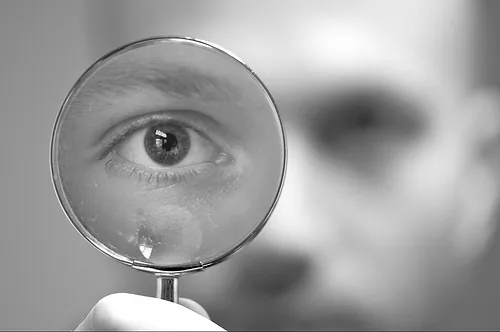
“The unexamined life is not worth living,” said the great management thinker Socrates.
Every day, people say that they’ll change. At the beginning of every year, millions make resolutions. Most do this without data, hypotheses or any idea of what they’re going to do differently. And they wonder why nothing really changes.
Intention without information is powerless. To misquote great management thinker, Albert Einstein, doing the same thing and hoping for a different result is the definition of inefficiency.
This is where the personal time and motion study can help.
Time and Motion Study Basics
In summary, it goes like this:
1. Look closely at what you’re doing.
2. Spot opportunities to be more efficient
3. Make a change to the way you work to do it
4. See if it produces the expected results
5. Rinse and repeat
(Note: a traditional Taylorist time and motion study separates thinking about work versus actually doing it. You can tell who’s doing the thinking because they’re wearing a suit and an expensive watch. That approach, though still common, is somewhat discredited and is not what we’re talking about here.)
Small changes, big benefits
Small savings quickly mount up. At the same time, we spend a lot of time in our lives doing stuff that is not very useful. For example, in your life you spend two months driving the street in front of your house. (Or so says David Eagleman in his marvelous book, Sum.)
Reducing useless tasks or at least doing them more efficiently can free up huge amounts of time for what’s important. Here’s a table to help you work out how much time you could save with modest gains repeatedly regularly:
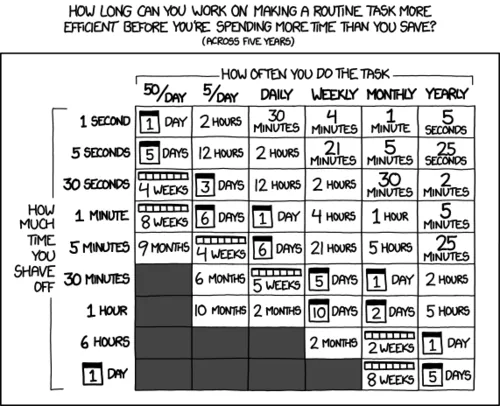
is it worth the time? It’s a question worth asking yourself for whatever you’re doing — even if your intention is to be more efficient and productive.
Pay attention
In the Atlantic, Megan Garber describes MIT psychologist Sherry Turkle’s working method as “the kind of low-grade spying that in academia is known as ‘ethnography,’ that in journalism is known as ‘reporting,’ and that everywhere else is known as ‘paying attention.’”
This is what you’re aiming for: pay attention to what you do and how you do it.
Start by thinking, in broad terms, about how you spend your time over the course of a typical working week. Time trackers like Harvest can help. RescueTime, which tracks the applications and websites you use, may give you more objective data about how you spend your time. Simply writing things down may be enough.
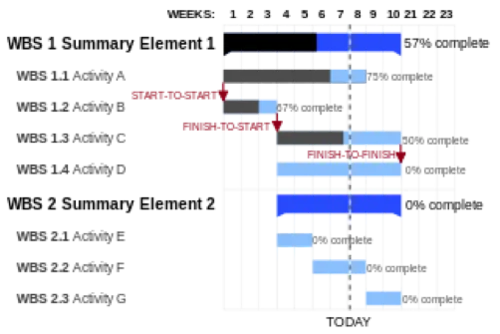
You don’t need to produce this kind of Gantt chart or measure your activity down to the second. That would be Taylorism — and you are both the subject and the observer, the thinker and the doer. Examine and report on your life in a way that’s useful.
Spot opportunities for improvement
Group your time into categories using a classic Boston Box with amount of time spent and value on the two axes.
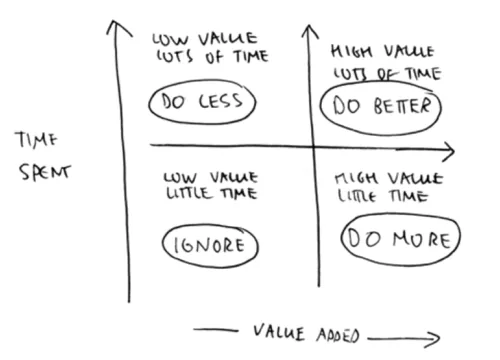
You already have data about the amount of time spent from your observations. Here are some criteria for judging how valuable an activity is to your job:
- Does it create value for the business?
- Is it in my job description?
- Do I get a bonus for doing it really well?
- Does Seth Godin think it’s important?
There are some things, like going to meetings or writing emails, that are part of your job but they’re not valuable. Once you’ve classified your tasks this way, you can see where you need to spend time and what you need to adjust.
Create a hypothesis
Common ways to be less efficient are good places to start looking for improvements. Do you do any of these things?
- Spend too much time on email. Email takes up around 28 percent of the average desk worker’s day. That’s a day and a half a week.
- Interrupt yourself. Each day a typical office employee checks email 50 times and uses instant messaging 77 times. It’s hard to concentrate if you’re doing this.
- Multi-tasking. Productivity drops by as much as 40 percent when subjects try to do two or more things at once.
From your own observations, come up with a question or hypothesis that addresses these common behaviors, such as “can I cut the amount of time I spend doing my email by 25 percent?” and what you discover about how you spend your time, such as “can I find a way to replace or reduce some kinds of meetings?”
Make a change
Once you’ve got a hypothesis, make a change in the way you work and run an experiment to see if it helps. Here are some tools and techniques for doing less and doing better:
- Consider using the Pomodoro technique to improve concentration.
- Change the venue for your work. For example, try shared workspaces or working on the underground.
- Go to fewer meetings or just email a report instead of attending.
- Use an online tool, such as Tricider, to build consensus rather than spending an hour in a meeting.
- Switch off your email notification and other interruptions. Put your phone into airplane mode and use a distraction-free editor.
- For your email, set up some rules for routine messages, some autoresponders, and some canned responses.
Evaluate results
Try your experiment for a week. Perform the same observations as before using the same tools. Is there an improvement? Great. If not, try something else. Rinse and repeat.
A few minutes every day and an hour or so every week working with time and motion study experiments can produce a dramatic change in your productivity.
What helps you to be more efficient? What tools do you use to measure your effectiveness? What holds you back? Share your thoughts in the comments. We’d love to hear from you.
Liked this guest post? Subscribe to our free newsletter for more great content on productivity, management, and how to work better!
Images: [1] Bart van de Biezen/Flickr (eye); [2] XKCD (time chart)