 Oz
OzFocus · 9 min read
Reduce Workplace Distractions With an AI Teammate
Workplace distractions cost knowledge workers over 23 minutes of focus per interruption. Learn why it's a structural problem—and how to address it.
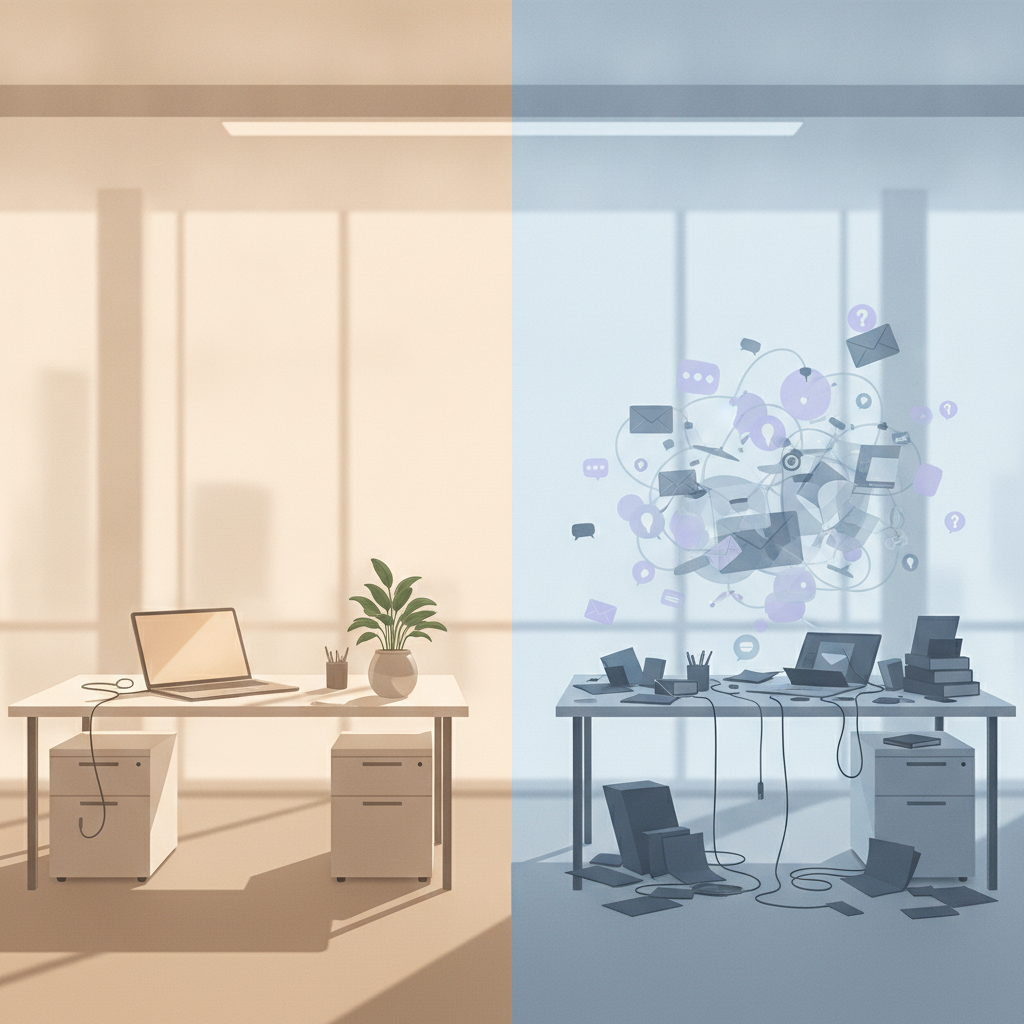
Workplace distractions are not a personal discipline failure. They are a structural problem built into the architecture of modern work—and understanding that distinction is the first step toward doing something meaningful about them.
The average knowledge worker loses 23 minutes and 15 seconds of deep focus after a single interruption, according to research by Gloria Mark at UC Irvine. Multiply that by the number of times you're interrupted each day, and the math becomes alarming fast.
The 23-Minute Rule: What One Interruption Actually Costs
Most people dramatically underestimate the true cost of a distraction. The intuition is that a quick glance at a message or a short hallway conversation costs only the time it takes. The research says otherwise.
Research by Gloria Mark at UC Irvine shows it takes an average of 23 minutes and 15 seconds to fully regain deep focus after a single disruption. And critically, people don't jump directly back to what they were doing — there are typically two intervening tasks before the original work is resumed.
That means a single ping from a chat app doesn't just steal the seconds it takes to read the message. It triggers a cascade of cognitive switching that can consume the better part of half an hour before sustained focus is restored.
Interruptions tap disparate cognitive operations, from attention to decision-making to memory — which is why recovery feels harder than it should. Each interruption doesn't just pause your work; it partially dismantles the mental model you were building.
Working memory resources are relied upon during the pursuit of cognitive task goals, suggesting that interruptions may disrupt the ability to maintain task-relevant information in mind. Rebuilding that scaffolding after every disruption is cognitively expensive.
Two Decades of Shrinking Attention Spans
The problem has been getting worse for twenty years, and the trajectory is not encouraging.
That is a collapse of more than 95% in sustained screen attention over roughly two decades. The cause is not that workers have become less capable or less disciplined. Technology has been designed with the intent to augment our capabilities and help us produce more, but we are also distracted and exhausted in our everyday use with it. The design of the tools themselves — notifications, algorithmic feeds, real-time messaging — is oriented toward capturing attention, not preserving it.
This matters because it means individual willpower is fighting against systems deliberately engineered to interrupt. That is an unequal contest.
The Notification Machine: 275 Interruptions a Day
The scale of the notification problem in contemporary workplaces is difficult to appreciate until you see it quantified.
Employees are interrupted every two minutes during core work hours — 275 times a day — by meetings, emails, or chats. According to Microsoft's data, employees receive an average of 117 emails and 153 Teams messages each workday.
With 275 potential interruptions per day and a 23-minute recovery window per interruption, the theoretical attention debt would vastly exceed a standard workday. Of course, workers adapt — by working faster, by skimming rather than reading deeply, by shifting cognitive gears more quickly. But adaptation has a cost. Many working conditions impair cognitive performance; fragmentation of work, multitasking, and information overload have proven to be typical straining features in knowledge work.
In high-stakes domains the consequences are more severe. In healthcare settings, task-related stressors including interruptions have predicted higher levels of attention failure, mediating the influence of workflow interruptions on near-accidents. The office environment carries different stakes, but the underlying cognitive mechanism is the same.
Coordination Work: The Hidden Distraction
Not all interruptions arrive as notifications. A substantial portion of the distraction problem is structural — it is baked into how work is organized, not just how it is communicated.
This is a remarkable finding. The majority of a knowledge worker's time is not spent doing the thing they were hired to do. It is spent on the organizational connective tissue that surrounds the work: the status updates, the meeting prep, the follow-up messages, the inbox triage.
Communication dominates the workday, consuming 60% of user time through emails, chats, and meetings, leaving only 40% available for creative tasks such as synthesizing information or creating analysis documents. When the majority of the day is consumed by coordination, skilled work is necessarily confined to the margins.
The irony is that many of these coordination tasks are not intellectually demanding — they are simply time-consuming and attention-fragmenting. They do not require the same cognitive depth as the strategic work they displace, but they carry enough cognitive switching cost to prevent that deeper work from ever getting started.
Why More Tools Can Make Things Worse
One instinct when facing a productivity problem is to add a new tool. The evidence suggests this requires caution.
Focus efficiency fell to a three-year low of 60%, because more AI tools created more outputs to manage, more coordination, and more reasons to check another screen. Tool proliferation without intentional workflow design can increase the coordination burden even as it promises to reduce it.
48% of employees and 52% of leaders reported that work feels "chaotic and fragmented," and 80% of global workers said they lack sufficient time and energy to do their work. These are not the numbers of a workforce that has been successfully aided by its tools.
The question is not whether to use technology, but how to use it. The goal should be reducing the coordination overhead that consumes 60% of the workday, not adding another surface that demands attention.
What Actually Works: Changing the Information Architecture
This reframes the problem usefully. The issue is not that workers need to try harder or want to focus less. The issue is that the information systems around them demand constant cognitive overhead that eats into the time and energy available for deep work.
Several structural approaches have shown value:
Scheduled Focus Blocks
Blocking time explicitly for uninterrupted work — and communicating that to colleagues — reduces the social permission for interruption. When Intel's Software and Services group instituted scheduled "think time" on shared calendars, employees were freed from the expectation of immediate response during those hours. The protected time allowed for the kind of sustained concentration that produces substantive output.
The key is that focus blocks must be visible and legitimized at the organizational level, not just practiced individually. A personal calendar block is easy to override; a team norm is harder to break.
Notification Architecture Redesign
Rather than relying on individual restraint, teams can redesign the notification environment itself. Batching email responses to two or three fixed times per day, turning off non-urgent push notifications during deep work periods, and establishing explicit response-time norms all reduce the ambient interrupt rate without requiring heroic self-control.
The distinction matters: interruptions are the norm in almost every workplace, which means reducing them requires changing the norm, not just the individual.
Delegating Coordination Work
If 60% of knowledge worker time is consumed by coordination tasks, and coordination tasks are the primary source of structural interruption, then reducing coordination overhead has a disproportionately large impact on available focus time.
This is where delegation — to colleagues, to systems, or to AI tools specifically designed to handle coordination — offers meaningful leverage. Status updates, follow-up messages, information retrieval, and task routing are all coordination activities that do not require the deep cognitive engagement of strategic work. Offloading them preserves the attention budget for the work that does.
Where Oz fits
Oz by Anyreach is an AI teammate you can ask in Slack, Microsoft Teams, email, on the web, or on a call. Oz can use connected tools to help complete work, and every risky action asks for approval first. Learn how I Done This is transitioning to Oz.
The Economic Toll of Distraction
The costs described above are not just personal inconveniences. They aggregate into substantial economic losses.
Cognitively straining working conditions not only directly impair cognitive functioning and task performance — they also contribute to burnout, errors, and attrition. Workers who consistently operate in fragmented, interruption-heavy environments are more likely to experience stress and reduced job satisfaction, which has downstream effects on retention and organizational performance.
The workers most harmed by this dynamic tend to be those doing the most cognitively demanding work. Sustained creative and analytical thinking requires extended, uninterrupted cognitive engagement — exactly what a 275-interruption workday makes structurally impossible.
A Framework for Reclaiming Focus
Reducing workplace distractions is not about achieving perfect silence or eliminating all communication. It is about redesigning systems so that the default is focused work, with interruption as the exception rather than the constant background state.
The evidence points toward a few consistent principles:
Diagnose before you prescribe. Count your actual daily interruptions for a week before deciding on interventions. The number may be larger than your intuition suggests, and knowing it precisely makes the case for structural change more convincing to colleagues and managers.
Target coordination overhead specifically. Because coordination tasks represent the majority of the interruption load, interventions that reduce status-chasing, follow-up messages, and redundant meetings will have the highest return on attention.
Make focus time visible and legitimate. Individual discipline is insufficient when organizational norms treat immediate availability as the default professional expectation. Sustainable focus requires organizational permission, not just personal resolve.
Be skeptical of tool additions. Every new platform is a new notification surface. Evaluate tools by whether they reduce coordination overhead or increase it — not just by their feature list.
The goal is not to be the Mozart of multitasking. It is to create the conditions under which sustained, high-quality thinking can happen consistently — and to recognize that those conditions are structural, not personal.
Frequently asked questions
How long does it actually take to recover focus after an interruption?
Research by Gloria Mark at UC Irvine found it takes an average of 23 minutes and 15 seconds to fully regain deep focus after a single disruption. Recovery is also non-linear: people typically complete two intervening tasks before returning to the original work.
Why can't people just ignore notifications when they need to focus?
Research suggests the barrier is largely environmental rather than motivational. Studies indicate that 76% of people cannot resist a notification for five minutes, and 59% cannot sustain focus for 30 minutes. Notification systems are designed to capture attention, making individual willpower an inadequate defense without structural changes to the environment.
How much of a knowledge worker's day is spent on coordination versus actual skilled work?
According to Asana's Anatomy of Work Index — drawn from a global survey of over 10,000 knowledge workers — 60% of the average knowledge worker's time is consumed by coordination activities such as status updates, searching for information, switching between apps, and chasing follow-ups, rather than skilled, strategic work.
Has average attention span really changed over the past two decades?
Yes, significantly. When Gloria Mark began studying the topic in 2004, people spent an average of two and a half minutes on any given screen before switching. More recent data puts that figure at around 47 seconds — a substantial decline that researchers attribute in part to how technology platforms are designed.
Does adding more productivity tools help with distraction?
Not necessarily. Data suggests that focus efficiency fell to a three-year low partly because more AI and productivity tools created more outputs to manage, more coordination tasks, and more notification surfaces. Tools that reduce coordination overhead can help; tools that add another channel to monitor may make the problem worse.
What is the most effective structural change a team can make to reduce interruptions?
Evidence points to redesigning the information architecture around work rather than relying on individual willpower. Practically, this includes establishing shared focus-block norms on calendars, batching communication to set times, reducing redundant status meetings, and delegating routine coordination tasks so that skilled workers spend more of their time on substantive work.
Are some workers more affected by workplace distractions than others?
Research suggests that cognitively demanding roles — those requiring sustained analytical or creative thinking — are disproportionately harmed by high-interruption environments, because deep work requires extended uninterrupted engagement. In healthcare settings, interruptions have even been linked to higher rates of attention failure and near-accidents, illustrating that the stakes of fragmented attention vary significantly by role.